
The Pinnacle Dive
Underwater in Komodo where the ocean rages, fish swarm and predators circle

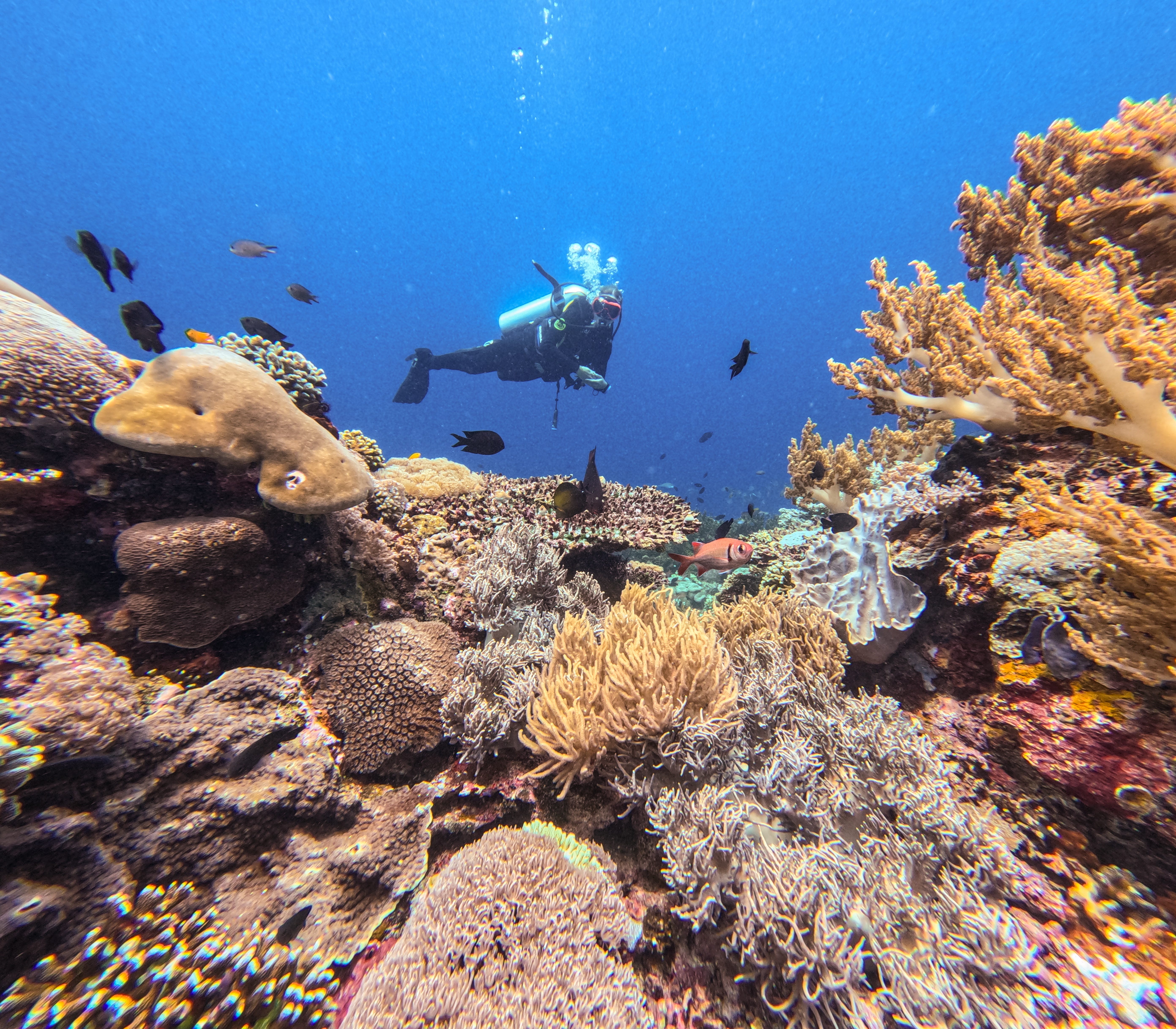
Outside, the ocean streamed past like a river in flood—its surface boiling, spinning, dragging itself into whirlpools. Komodo sits deep within Indonesia’s Coral Triangle, right at the collision point of the Indian and Pacific Oceans, where extreme tidal forces funnel vast amounts of water through narrow straits. It results in some of the strongest currents on Earth.
Somewhere beneath the turmoil, a rocky coral-covered pinnacle rose straight out of the inky depths, stopping just five metres below the surface. The top is tiny—nothing more than the summit of an underwater mountain, battered not by wind but by perpetual, gale-force water. It’s an intimidating place. But it’s also a magnet for life and one of the region’s great dive sites.
Bright corals cling to the rock, pristine and thriving, fanned constantly by colder, nutrient-rich water. Small fish and crustaceans hide among them. Those little fish attract bigger fish, and bigger fish again. The currents carry plankton, which summons vast balls of baitfish. Predators gather in the blue, their sleek shapes patrolling the edges.
The current here is far too strong to swim against and trying to “dive around” the pinnacle would just send you cartwheeling past it. Even underwater, the flow shudders your mask and whips your hair straight back as though in an open air convertible. It’s pointless to resist.
Instead, the dinghies took us a few hundred metres upstream of the pinnacle where they idled in the current as we got ready to dive. It’s deep here—the water a dark indigo, with long shafts of sunlight spearing into the blue.
We strapped on tanks and masks, tightened our fins and rolled backwards off the boat into the sea using a negative entry—dumping all the air from our BCDs (inflatable vests used to control buoyancy underwater) so the weight of the gear would drag us under the moment we hit the surface. Time spent bobbing at the top, where the water moves fastest, is the quickest way to miss the pinnacle entirely.
We regrouped underwater, each flashed the ok signal, kicked hard and dropped fast, hoping to reach around thirty metres (one hundred feet) before the current swept us past our target.
It’s a surreal feeling sinking into the blue when the bottom is invisible. Some find it disorienting, the inky darkness below unnerving. But I enjoy the moment of total surrender, free-falling as the pressure shifts, the ocean pulling me downward into the abyss, relinquishing any sense of control. There’s no reference point except the shrinking light above and the numbers on your dive computer. You lose red light rapidly as you descend, the water absorbing its longer wavelength, until everything becomes another shade of blue.
Whatever petty worries you carried are left on the surface for the squabbling gulls the moment you slip beneath the salt water. A brief amnesia washes over you—air-side concerns dissolve—yet something older stirs. A deep, half-remembered memory runs through your salty veins, reminding you that this ocean was once your home. Free falling into the abyss, deeper and deeper, feels natural, ancient, welcoming.
Underwater, writes Jacques Cousteau:
You forget the sun. You forget a lot.
Down at thirty metres however, I try not to search too intently for the surface. It’s a long way back to the top, and nothing good comes from dwelling on it.
Out of the blue in front of us a mass of rock emerged. It was closer than expected and getting closer. Within moments we were on it and moving past it, the relentless current pushing us around the side already. Trying to stabilise in the flow, we unfurled reef hooks—simple ropes with a metal hook on the end— and, finning hard and avoiding the delicate coral, jammed the hooks into rock crevices to keep from being swept away. The lines drew tight, giving us a firm hold. Anchored to the reef, suspended in the torrent and finally still, we could look up and take in the scene.
All in front of us was open ocean. Below, the pinnacle dropped even deeper into the impenetrable blue. To the right and left, the current tore past the edges of the rock. Giant schools of neon blue and yellow fusiliers darted around us, colours streaked like laser beams, feeding on the plankton and detritus drifting past. Smaller reef fish—damsels, butterflyfish, idols—hugged the reef and aimed into the current. Busy, colourful wrasses darted about with purpose whilst parrotfish glided by with a toothy grin.
In each direction, white tip reef sharks held steadily in the current, finning like trout in an alpine river. Some were small: juveniles hugging the rocks, no bigger than a meter. Others were big. One in particular lay a few meters up and over our right shoulder in the blue water, around two meters long it held steady and with small flicks of its tail it drifted closer and then moved away.
For the uninitiated, the bottom of the sea likely seems a silent, tranquil place. But that couldn’t be further from the truth, it’s awash with strange new noises. The coral crunching of parrot fish, the steady whine of a boat, the relentless snap and crackle of tiny shrimps, the distant echo of large mammals. The sounds don’t just reach your ears but pass straight through you. Down here, your whole body listens.
A sharp “boom” cracked overhead as the fusiliers scattered in unison. The sound comes from the rapid vibration of their swim bladders which are equipped with special sonic muscles. Done together, it creates a loud, disorientating sound which confuses predators. An underwater flash bang. It’s a sure fire indicator that something exciting is happening. I looked up to see a huge, mean looking dogtooth tuna—large eyed, large teethed, large sized—circling the school, silhouetted against the faded sun, waiting for a straggler.
We lingered there, watching the show whilst being jostled by the current, for as long as caution allowed. When diving at this depth, the water pressure forces tiny bubbles of nitrogen out of your bloodstream and into your tissues. Ascend too fast and these bubbles expand as the pressure drops, turning something invisible into something very dangerous. The “bends” or “decompression sickness” is something all recreational divers are trained to avoid. The deeper you go the thinner the margin of error.
So we keep to the rules and dive conservatively, limiting bottom time at depth and ascending slowly to allow time for the bubbles to naturally work their way out of our system. Modern dive computers make these calculations effortless: they tell you in real time exactly how long you have left at certain depths, how fast you need to ascend, when to stop and for how long.
Watching our gauges, we worked our way upward in stages. Unclipping from the reef hooks, we’d flail in the current for a few seconds before it swept us naturally up the flank of the pinnacle. Every few meters we clipped in again and paused for a few minutes to stare out into the blue. As we climbed, colour returned, the reef brightened, tropical fish multiplied and the current grew fiercer.
At five meters — the summit of the underwater mountain — we tucked ourselves behind, into the lee of the rock, sheltered from the flow. Then, as always, one final precaution: a safety stop at five meters for three minutes to let the last of the nitrogen drift away. The current hammered us, shoving us into one another as we gripped the rock, refusing to be torn loose. It was a long three minutes.
By the time the computers released us, we were battered but buzzing, the rock slipped from our hands as we kicked for the surface. Breaking into the open air, the current swept us like leaves, already carrying us hundreds of meters from where we’d begun. We hung there, scattered across the water, waiting for the boats—hearts thumping, limbs shaking, and grinning like fools. Exhilarated. Spent. A little drunk on the madness of it all.
Until next time.
If you enjoyed this story of being at the bottom of the world, perhaps you will enjoy one about standing on its roof. Altitude sickness, avalanches and glaciers on the world’s eighth highest mountain at the link below.
Amazing experience and amazing writing!!
This is remarkable writing — it brought me straight back to being a kid watching Nature on PBS when George Page narrated.
I used to get extra excited whenever the episode slipped into those underwater worlds, especially after we finally got our first color TV. There was a kind of reverence in those moments — like seeing a hidden chamber of the planet.
The way you describe sinking through that blue… I felt that.
That surrender, that ancient memory, that smallness that feels like a kind of truth.
I’ve never dived Komodo, but reading this makes me wonder what other corners of the planet hold stories this intense — and how many we’ll never fully extract from the deep.
Beautiful work.